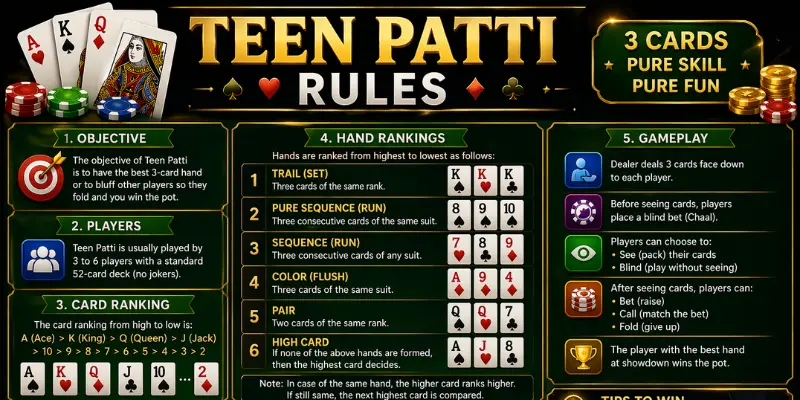
Teen Patti — literally meaning 'Three Cards' — is South Asia's most beloved card game. Played at family gatherings, Eid celebrations, and now on millions of smartphones, it's a game of strategy, psychology, and controlled risk. If you're new to 3 Patti Ludo, understanding the rules is your first step to winning consistently.
01The Basics: How a Round Works
Teen Patti uses a standard 52-card deck (no jokers). Each player is dealt three cards face-down. The goal is to have the best three-card hand compared to other players — or to be the last player remaining after everyone else folds.
Before cards are dealt, every player places a mandatory 'boot amount' (ante) into the pot. This creates the initial prize pool that the winner collects.
02Card Rankings — Highest to Lowest
- 1Trail (Three of a Kind) — Three cards of the same rank. Three Aces is the highest possible hand.
- 2Pure Sequence (Straight Flush) — Three consecutive cards of the same suit. A-2-3 is the highest pure sequence.
- 3Sequence (Straight) — Three consecutive cards of mixed suits.
- 4Color (Flush) — Three cards of the same suit, non-consecutive.
- 5Pair — Two cards of the same rank. Higher pair wins; if equal, the third card (kicker) decides.
- 6High Card — None of the above. Highest individual card wins.
03Blind vs Seen Players
This is what makes Teen Patti uniquely psychological. After the deal, you choose whether to look at your cards (become a 'Seen' player) or keep them face-down (play 'Blind').
Blind players bet half the current stake amount, while Seen players bet the full stake. Playing blind costs less but you're taking a risk without information. Strategically, starting blind creates the impression of extreme confidence — even if you have weak cards.
04The Sideshow
A 'Sideshow' (also called a Compromise or Back Show) allows a Seen player to privately compare cards with the previous Seen player. The player with the lower hand must fold. The previous player can accept or refuse a sideshow.
A refusal to sideshow typically signals a strong hand. An acceptance suggests the player wants to eliminate a potential threat. Read these signals carefully.
05Betting Rounds and Winning
Betting continues clockwise around the table. Each player can Call (match the current bet), Raise (increase the bet), or Pack/Fold (quit the hand, losing their contribution to the pot).
The round ends when only two players remain and one calls for a show (pays to reveal cards), or when everyone folds except one player. In a show, the player with the higher-ranked hand wins the pot.
06Common Beginner Mistakes
- Calling too many rounds with weak hands hoping for a 'comeback'.
- Never playing blind — you miss a major psychological tool.
- Ignoring table limits and running out of chips mid-game.
- Not paying attention to how opponents bet with strong vs weak hands.
- Going all-in too early in a session before understanding the table dynamics.
07Practice Before Playing with Real Money
3 Patti Ludo offers free-chip practice tables where you can play without risking real PKR. Spend at least a few sessions on practice tables before depositing. The mechanics become second nature quickly, but developing your read on opponents takes time and real game experience.
Ready to play 3 Patti Ludo?
Download the APK, claim your welcome bonus, and apply what you just learned.